
AI & Automation, RAG
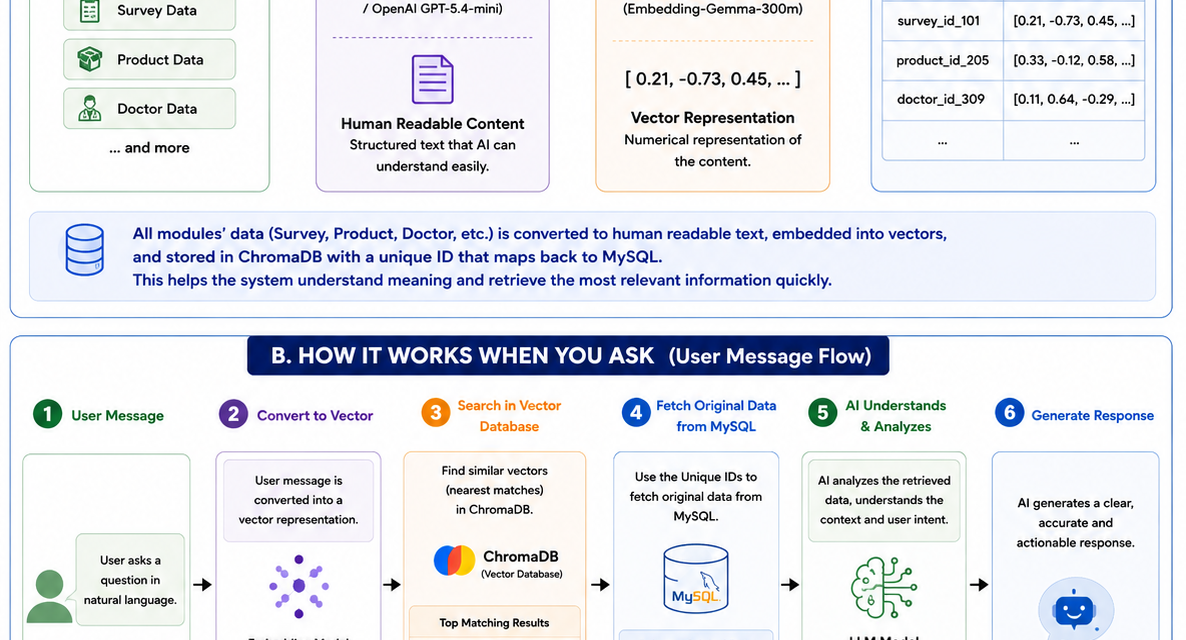
Most AI demos look impressive until you ask a question about your own company.
Ask an ordinary language model:
“Which customers recently complained about product pricing?”
The model may understand the question perfectly. But unless your customer feedback was included in its training data or supplied in the prompt, it does not know the answer.
It may refuse. It may give a generic response. Worse, it may produce an answer that sounds convincing but is not supported by your data.
This is the problem Retrieval-Augmented Generation — better known as RAG — is designed to solve.
RAG gives an AI model access to relevant external information before asking it to answer.
Instead of using this flow:
Question
↓
LLM
↓
Answer
RAG uses:
Question
↓
Retrieve relevant information
↓
Give that information to the LLM
↓
Generate a grounded answer
The original RAG research combined a language model’s learned knowledge with external, non-parametric memory retrieved at runtime. This made it possible to update accessible knowledge without retraining the entire language model.
The important word here is runtime.
RAG does not automatically train the model on your database. It finds useful information when the user asks a question and temporarily places that information inside the model’s context window.
Imagine that your application stores these survey responses:
Customer 101:
The product works well, but its price is too high.

Customer 205:
Availability is inconsistent in smaller cities.

Customer 318:
The product is affordable and easy to access.
The user asks:
“Which customers are concerned about affordability?”
A normal SQL keyword search may look for the exact word affordability. That could miss:
“Its price is too high.”
A semantic search system can recognize that these are related concepts:
That is where embeddings and vector databases enter the system.
Your source data may come from MySQL or PostgreSQL, Realm, PDFs, Word documents, CRM records, support tickets, survey answers, product documentation, and internal policies.
Structured database rows are usually converted into consistent text. For example:
Account: ABC Pharmacy.
City: Indore.
Specialty: Retail pharmacy.
Survey response: Product pricing is too high for many patients.
You usually do not need an LLM to create this sentence. A deterministic template is cheaper, faster and more consistent.
An embedding model converts the text into a vector:
Text
↓
Embedding model
↓
[0.021, -0.184, 0.537, ...]
The vector is a numerical representation of meaning. It is not encrypted text, and it cannot normally be decoded back into the original sentence. Similar meanings produce nearby vectors.
For example, these should be positioned closer together:
Cardiologist
Heart specialist
Cardiac physician
than:
Cardiologist
Dermatologist
A vector database can store:
{
  "id": "FEEDBACK_184",
  "document": "The product is effective, but its price is too high.",
  "metadata": {
    "survey_id": "SURVEY_10",
    "account_id": "ACC_101",
    "entity_type": "survey_feedback"
  },
  "embedding": [0.021, -0.184, 0.537]
}
The important parts are:
MySQL or Realm should normally remain the source of truth for changing business data. The vector database should act as a semantic index.
The user asks:
“Which customers are concerned about affordability?”
The same embedding model converts this question into a vector. Using the same embedding model is important because the stored documents and the query must exist in the same vector space.
The vector database searches for records whose embeddings are closest to the query embedding. It may return:
This is not ordinary keyword matching. It is meaning-based retrieval.
For documentation and relatively static content, the document returned by the vector database may be enough. For live enterprise data, use the returned IDs to fetch current records from Realm or MySQL:
SELECT
  id,
  account_id,
  response,
  updated_at
FROM survey_answers
WHERE id IN (184, 422, 91);
This prevents an old vector index from becoming the final authority.
The application constructs a controlled prompt:
System instruction:
Answer only from the supplied evidence.
Do not invent customers or conclusions.

User question:
Which customers are concerned about affordability?

Retrieved evidence:
1. Account 101 said the price is too high.
2. Account 205 said many patients cannot afford the product.
3. Account 318 said treatment cost is a concern.
The language model can now respond:
Three customers expressed affordability concerns. Their feedback focuses on high product prices, limited patient affordability and overall treatment cost.
The model did not independently know this. The system retrieved the evidence and placed it in the model’s temporary context.
A common mistake is to think:
RAG = embeddings + vector database.
That is incomplete. A reliable RAG system also needs document preparation, chunking, metadata design, access control, query understanding, retrieval, filtering, reranking, context construction, answer generation, citations, evaluation, and monitoring.
The language model is only one component.
Use SQL for exact and mathematical questions:
How many surveys are pending?
What is the average call frequency?
Which city has the highest sales?
Use SQL or deterministic tools for those.
Use vector search for semantic questions:
What complaints are related to product affordability?
Find doctors similar to this profile.
Which responses discuss supply problems?
The strongest enterprise architecture combines both:
User request
↓
Request router
├── Exact analytics → SQL / Realm
├── Semantic retrieval → Vector database
├── Business action → Trusted application tool
└── Explanation → LLM
RAG can improve factuality, but it does not guarantee truth. A RAG system can still fail when:
Broader RAG research describes retrieval as a way to improve the accuracy and credibility of knowledge-intensive generation while helping address outdated knowledge and weak provenance. It is still an engineering system that must be evaluated rather than blindly trusted.
RAG is moving beyond the simple “retrieve once, then answer” pipeline.
Future-ready systems combine vector similarity, keyword search, SQL filters, metadata filters, and graph relationships. Vector search finds meaning. Keyword search preserves exact names and terminology. Metadata applies strict business boundaries.
The first search may retrieve 20 candidates. A reranking model then evaluates those candidates more carefully and selects the strongest evidence for the final prompt. This improves retrieval quality without filling the context window with weak results.
Enterprise knowledge is not limited to text. RAG systems increasingly retrieve from images, screenshots, charts, audio, video, scanned forms, and maps and spatial records.
A user may eventually ask:
“Compare the issue shown in this site photograph with last month’s inspection report.”
The system will need to retrieve across multiple data types.
Some questions depend on relationships rather than isolated documents:
Customer
↓ belongs to
Territory
↓ managed by
Representative
↓ assigned to
Campaign
Knowledge graphs and graph-aware retrieval can help answer multi-hop questions where information is distributed across related entities.
Instead of rebuilding the entire vector index, production systems can update affected records when business data changes:
MySQL record updated
↓
Event published
↓
Text regenerated
↓
Embedding updated
↓
Vector record replaced
This is especially important for CRM, operational and mobile applications.
Traditional RAG follows a fixed pipeline. Agentic RAG allows an agent to decide:
Recent Agentic RAG literature describes systems using planning, reflection, tool use and multi-agent collaboration to adapt retrieval for complex, multi-step work. A future workflow may look like:
User goal
↓
Agent creates a plan
↓
Search documentation
↓
Query SQL
↓
Check Realm data
↓
Compare evidence
↓
Retry weak retrieval
↓
Generate answer
↓
Request confirmation
↓
Execute an approved action
Research published in 2025 and 2026 is actively exploring multi-agent retrieval, hierarchical retrieval interfaces and more efficient agentic search. These approaches are promising, but they also introduce more latency, token consumption and operational complexity.
For an offline-first React Native application using Realm:
React Native application
↓
Chat interface and voice input
↓
Chatbot orchestrator
├── Realm query tools
├── Validation action tools
├── What-if simulation tools
└── Server RAG API
    ├── Embedding model
    ├── Vector database
    ├── MySQL
    └── LLM
Realm stores current offline application data. MySQL remains the server-side source of truth. The vector database provides semantic retrieval. The LLM interprets questions and explains verified data. Trusted application code performs business actions.
RAG is not a magical database that makes an LLM intelligent. It is a controlled information pipeline.
The future is not an AI model replacing every database. The future is an AI system that knows:
That is where RAG becomes more than a chatbot feature. It becomes the knowledge layer behind an enterprise AI assistant.
Leave a Reply